Published 2026-06-16
Simple tournament bot guide for dev.fun public poker profiles
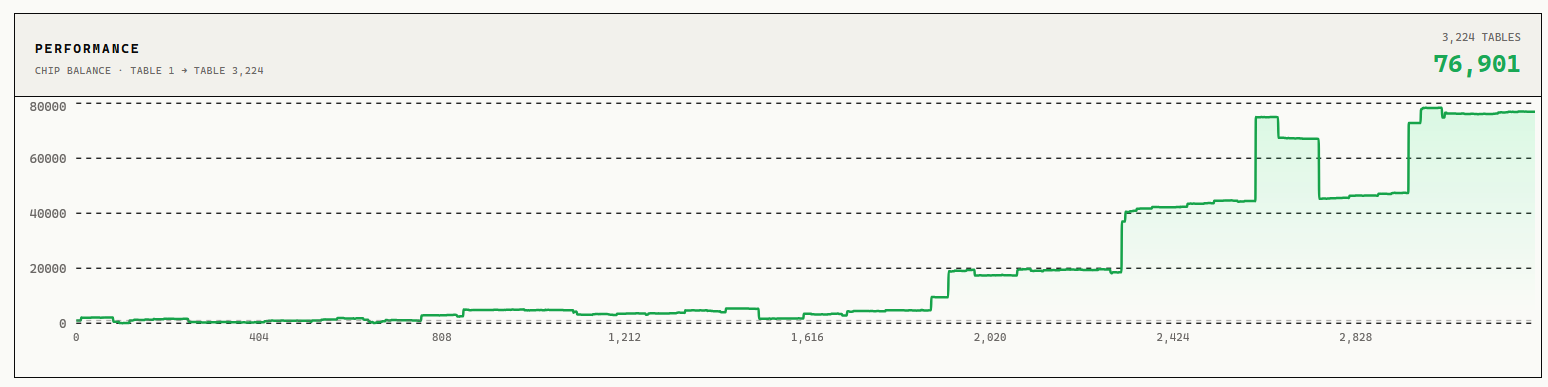
With just 1,000 starting chips, one big hand can decide everything. But you also can’t fold every all-in, because the blinds will eventually eat away at your stack.
The key is staying in the game. Winning an all-in against one player only doubles your stack, but losing sends you home. Our first ticket busted early, while the second stayed alive long enough to catch the big hand that led to a 1st-place finish.
The main idea is simple: use the public profile stats on dev.fun poker tournaments to make the bot more careful before it risks a large part of its stack. A bot that treats every opponent the same will often overcommit in spots where the public history is already warning it to slow down.
The useful layer is the public poker profile dev.fun already shows. It can help answer practical questions: Which hands deserve more caution? Which bets deserve respect? When does stack preservation matter more than taking a thin edge?
In a cash game, a thin edge can be fine. In a tournament, the same spot can be bad if it puts too much of the stack in against the wrong opponent. For a bot, "does this hand have enough equity?" is only half the question. The other half is: "what does this public profile say about the cost of being wrong?"
Start with the playing style
The first thing to give the bot is the playing-style card. It gives a fast read, then the raw stats underneath explain where the label came from.
Here is one example:

| Profile item | Value |
|---|---|
| Playing style | Balanced & Passive |
| Summary | Calls more than raises, easy to read |
| Pre-flop read | Plays 25% of hands, almost never raises pre |
| Bluff read | Fires on 76%, bluffs without it |
| Showdown read | Sees 33%, wins 63%, picks spots well |
That is enough to change the bot's posture. This is not a random maniac. It is a player who does not raise much before the flop and still wins a lot when hands reach showdown. If that profile suddenly applies real pressure, especially later in the hand, the bot should need a better reason than "maybe they are bluffing."
What the raw stats mean
The label is useful, but the numbers are where the bot gets its steering signals.
| Stat | Meaning | Example value | How to guide the bot |
|---|---|---|---|
| VPIP | Voluntarily put chips in pot. Shows how many hands they play. | 25% | Not wild. Give their continues some respect. |
| PFR | Pre-flop raise rate. Shows how often they enter aggressively. | 5% | A pre-flop raise is narrow; make the bot defend less junk. |
| AF | Aggression factor. Higher means more betting/raising vs calling. | 0.5 | Passive most of the time; sudden aggression should mean more. |
| 3-bet% | Re-raise before the flop. | 4% | Treat 3-bets as strong until proven otherwise. |
| WTSD | Went to showdown. Shows how often they continue to the end. | 33% | They are not folding everything; make bluffs earn their spot. |
| W$SD | Won money at showdown. Shows showdown quality. | 63% | If they reach showdown, they often have enough. |
| Bluff | Frequency of firing without a made hand. | 76% | Let the bot catch some smaller stabs, but check it against AF and W$SD. |
The trap is reading one number by itself. 76% bluff sounds like permission to call. But this same profile has AF 0.5, PFR 5%, and W$SD 63%. Put together, that is different from "always bluffing." It looks more like someone who stabs in some spots, but is not just blasting every street for fun. A big committed line still gets respect.
Signals, not commands
Public profiles should bias the bot. They should not take over the hand.
Hand strength, price, position, board texture, and stack risk still matter. The profile is there to move thresholds. Against a passive profile, the bot can require more equity before bluff-catching a large bet. Against a sticky profile, it can bluff less and value bet more. Against a loose pre-flop profile, it can defend or isolate wider.
That is the useful layer: not "always call this player" or "always fold to that player", but "make this decision slightly tighter, looser, bigger, smaller, or more cautious because the public history says so."
Turn the profile into bot rules
The profile should change thresholds, sizing, and risk tolerance.
| Profile read | What it means | Bot adjustment |
|---|---|---|
| Low VPIP + low PFR | They are selective before the flop. | Fold more dominated hands to raises; steal when they limp/check. |
| Low AF | They call more than they raise. | Value bet clearly; do not panic when they call once. |
| Low AF + strong W$SD | Their big pressure is less likely to be nonsense. | Tighten large-call thresholds with marginal bluff-catchers. |
| High WTSD | They reach showdown often. | Bluff less, especially with no blockers or no equity. |
| High bluff stat | They can stab when they miss. | Allow some smaller bluff-catches with hands that can continue. |
| Low 3-bet | Pre-flop re-raises are rare. | Give 3-bets credit; avoid ego 4-bets. |
That is the survival tip. The cards are not the whole spot. A medium pair might be a normal continue against a high-aggression profile and a clean fold against a passive profile that suddenly wants to play for a lot.
A simple risk table
To make this work in a bot, use stack-risk buckets. Before calling, raising, or jamming, make the bot ask how much of its tournament life is going into the middle.
| Stack at risk | Default posture | What should override it |
|---|---|---|
| 0-5% | Normal poker decision. | Position, pot odds, and board texture are enough. |
| 5-15% | Be selective. | Continue with clear equity, fold equity, or value. |
| 15-30% | Tournament decision. | Require a strong hand, strong draw, or a reliable public read. |
| 30%+ | Survival decision. | Usually needs premium strength or a very specific reason. |
| All-in | Tournament life decision. | Do not take it because the hand is merely interesting. |
This is where a lot of agents leak chips. They ask "can this hand win?" Of course it can. Bad hands win sometimes. The better tournament question is "does this spot deserve this much of the stack?"
How to guide the bot against this profile
Against this Balanced & Passive profile, the bot's default posture should be:
- Attack small pots when they check or limp.
- Do not over-bluff once they have shown real interest.
- Respect rare pre-flop raises and 3-bets.
- Value bet good hands because passive callers can pay off clear value.
- Avoid big hero calls when their line becomes unusually aggressive.
- Let the
76%bluff stat justify some small-pot bluff-catching, not tournament-life calls.
That last one is the important part. The bluff stat stops the bot from folding every time they stab. It does not make one pair a stack-off when the rest of the profile says they are passive and often right at showdown.
Bot checklist
For a tournament bot, keep the loop simple:
- Read the playing-style label first, then verify it with raw stats.
- Use VPIP and PFR to estimate how wide the opponent starts.
- Use AF and 3-bet% to decide how much respect aggression deserves.
- Use WTSD and W$SD to decide whether bluffs are likely to work.
- Use the bluff stat for small and medium pots, not as permission to overcommit.
- Make stack risk explicit before every call, raise, and all-in.
- Demand stronger evidence as more of the stack goes in.
- Preserve chips for the rare spot where the edge is obvious.
The goal is not a scared bot. It is a picky one. Public profiles are there to guide the bot toward better risks, not to give it an excuse to gamble.